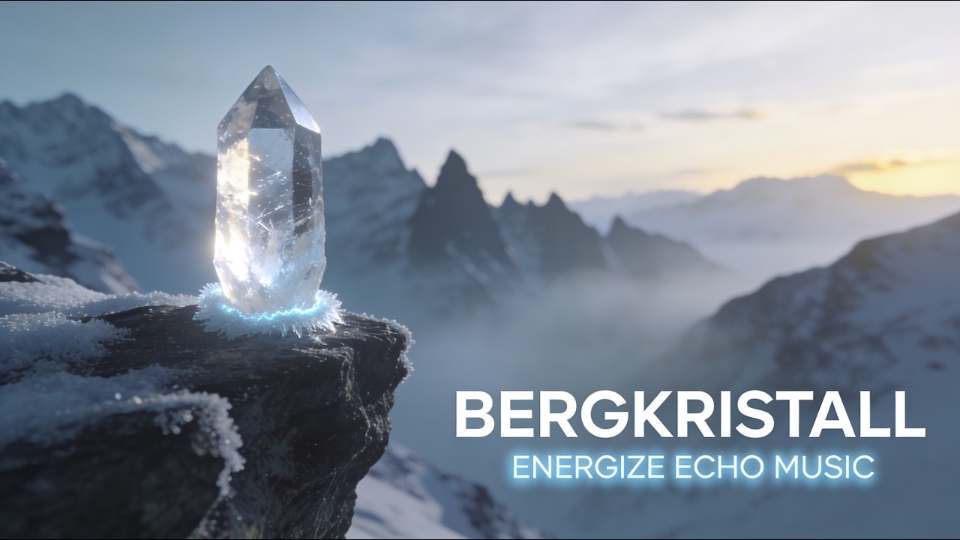
Some places don't make noise — they make clarity. Bergkristall captures that exact feeling: the cold stillness of a mountain ridge at first light, translated into crystalline synth textures, icy pluck melodies, and a minimalist bass that grounds you without pulling you down. This is focus music for people who think in systems and feel in landscapes.
The title isn't just poetic license. Silence, it turns out, doesn't really exist — not in the way we imagine it. In 1951, composer John Cage stepped into an anechoic chamber at Harvard, a room engineered to absorb 99.99% of all sound, expecting total quiet. Instead he heard two tones: one high, one low. An engineer told him the high one was his nervous system firing, the low one was his blood in circulation. Cage left convinced that "there is no such thing as silence" — that underneath every quiet moment, something is still humming. Modern versions of that same room, like the one at Orfield Laboratories in Minnesota, confirm the effect: strip away every external sound, and people start hearing their own heartbeat, their own breathing, their own body running in the background. Silence, at its absolute limit, has a frequency after all — it's just usually yours.
That's the quiet Bergkristall is actually built around: not the absence of sound, but the kind of stripped-back soundscape that lets whatever's already running in your head become audible to you. The track works because of what it leaves out. Research on music and cognitive load points to a consistent pattern: for complex, demanding thinking — the kind of systems-level problem-solving this track is built for — less is genuinely more. A dense, melodically rich track competes with your working memory; a sparse, predictable one doesn't. Complex cognitive tasks respond best to low-complexity audio precisely because the brain doesn't have to spend resources parsing what's coming next — it can predict the pattern and stop paying attention to it, freeing that attention for the actual problem in front of you.
That's also why the track stays minimal rather than filling every gap: predictable, low-complexity textures let your brain safely tune them out at a conscious level while they keep just enough structure running underneath to hold off silence-induced restlessness — the same discomfort that makes total silence in an anechoic chamber feel unsettling rather than peaceful after a few minutes. Bergkristall sits in the middle deliberately: quiet enough to disappear, present enough that your mind doesn't start filling the gap with its own noise.
Put it on when the work requires your full presence, when you're holding several moving parts in your head at once and need the auditory environment to stop competing for space. If Bergkristall's icy minimalism works for you, Ethereal Engine explores a similar stripped-back quiet from a different angle — mechanical rather than alpine, gears slowing rather than crystal forming. Stellar Study drifts even further out, into a spaciousness that's less mountain ridge and more open sky. Let the altitude do the rest.