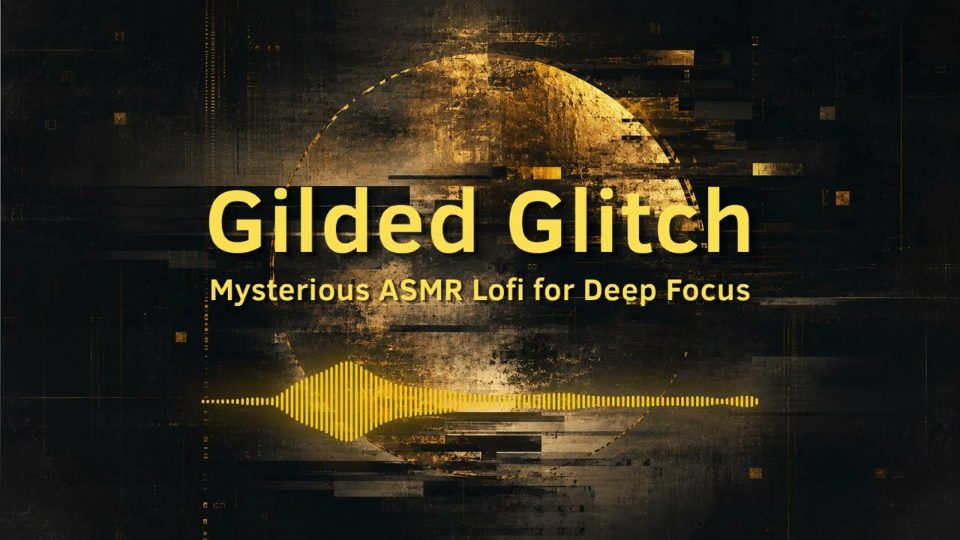
Something gold is trying to come through, but the signal keeps breaking up. That's the whole premise of Gilded Glitch: not perfection interrupted, but beauty that only exists because of the interruption — a transmission that's precious precisely because it can't quite hold together.
Warmth meeting static
The track opens on warm, golden ambient pads — rich, glowing, the kind of tone that usually signals safety and stillness. But almost immediately, soft glitch-static crackle pushes against it, fraying the edges. The two textures don't resolve into each other; they coexist in tension, gold light flickering through digital noise like a broadcast losing its connection mid-sentence.
A corrupted file, still somehow beautiful
Subtle bit-crushed piano notes drift through the mix, stuttering slightly, degraded just enough to feel intentional rather than broken. It's an odd effect — imperfection that reads as intimacy rather than error, the way a scratched photograph can feel more honest than a clean one. Beneath it, faint whispered murmurs move quietly, half-formed and half-heard, layered under a distant metallic shimmer that catches the light without ever fully resolving into melody.
Slow, secretive, unresolved
Everything moves at a deliberately slow 65 BPM — patient, almost cautious, like the track itself is aware of how fragile the signal is and doesn't want to rush it into collapse. The arrangement stays minimal and close-mic throughout, intimate rather than expansive, unfolding quietly rather than building toward anything.
When failure became a sound
Turning errors into music has a history. In the 1990s, the German project Oval built tracks out of deliberately damaged CDs, turning skips and digital stutters into rhythm and texture. In 2000, the composer Kim Cascone gave the idea a name in his essay "The Aesthetics of Failure," arguing that the glitches, clicks and artifacts of digital technology could be raw material rather than mistakes to hide. A whole strand of electronic music grew out of that thought. Artists such as Alva Noto and Ryoji Ikeda later pushed the idea further, building whole pieces from clicks, sine tones and digital noise.
Lofi carries a quieter version of the same instinct. Much of its sound goes back to early samplers and inexpensive gear with limited bit depth and sample rates, a grainy, slightly crunchy quality that producers now recreate on purpose with bit-crushing. Lowering the resolution of a sound strips away some detail, and what's left often feels softer and more human than a pristine recording.
How to listen to it
Gilded Glitch rewards attention more than most ambient tracks. Try headphones at a moderate volume and listen for the moments where the piano degrades and then recovers. On speakers in a quiet room it works differently: the static blends into the room, and the golden tones come through as a slow, warm glow. Either way, give it space. It belongs to the late, reflective part of the evening, not to a busy afternoon.
Gilded Glitch isn't about fixing the glitch or waiting for the signal to clear. It's about sitting inside that instability and finding it worth watching — something precious flickering in and out of focus, gold light behind static, never fully lost and never fully found.