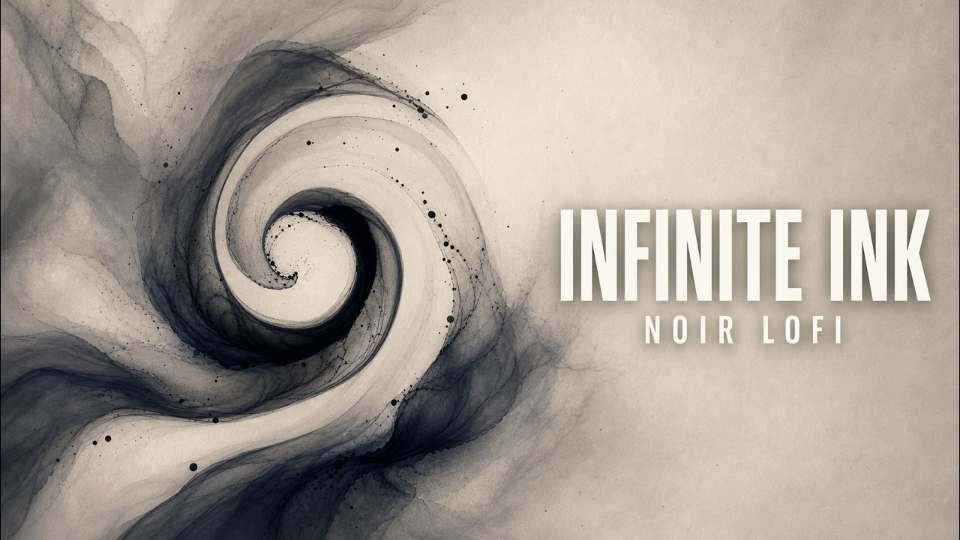
There is a version of focus that isn't calm — it's intense, shadowed, and completely consumed. Infinite Ink lives there. Haunting piano loops spiral over distorted lofi bass and deep shadow textures, slow and hypnotic at a tempo that pulls you under rather than lifting you up. Minor key melodies drift through grainy reverb layers like smoke through a dark room, and subtle tape hiss keeps everything raw and honest.
The word "noir" is doing real aesthetic work here, not just setting a vibe. Film noir's signature look — deep shadow, harsh contrast, a sense that something is fundamentally out of joint — traces directly back to German Expressionist cinema of the 1920s, films like The Cabinet of Dr. Caligari and M, made in the aftermath of a defeated, anxious Weimar Germany. When directors like Fritz Lang and Billy Wilder fled to Hollywood in the 1930s, they brought that visual language — chiaroscuro lighting, distorted angles, psychological unease rendered as literal shadow — with them, and it eventually curdled into what French critics in 1946 named "film noir": black film. The tape hiss and grainy reverb in Infinite Ink are the sonic equivalent of that same technique — a deliberate roughness that signals "this is not a polished, comfortable place," in exactly the way high-contrast shadow does on screen.
That intensity isn't just atmospheric, either — there's a real cognitive case for why a darker, heavier mood can sharpen a certain kind of work. Psychologist Joseph Forgas has spent decades studying what mild negative moods do to thinking, and the findings consistently cut against the assumption that happier is always sharper. Across a long series of experiments, Forgas found that people in a mildly negative mood pay closer attention to detail, are less prone to judgment biases, are better at detecting deception, and process persuasive information more critically than people in a positive mood. The mechanism his research points to is a shift in processing style: positive moods favor broad, associative, big-picture thinking, while negative moods push toward a slower, more externally focused, detail-driven mode — exactly the register that late-night editing, close revision, or unraveling a genuinely knotted problem tends to demand.
That's the actual case for Infinite Ink: not that a heavier mood is more pleasant, but that it's differently useful. The work that "goes somewhere unexpected" — the sentence that only comes out right on the fourth attempt, the thinking that requires sitting with an idea longer than feels comfortable — often responds better to a mind that's slowed down and turned inward than to a bright, expansive one.
This is music for the writing sessions that go somewhere unexpected, the late-night thinking that cuts deep, and the work that only happens when the rest of the world disappears. If Infinite Ink's intensity works for you, rain.loop channels a related late-night focus with a bit more warmth, and Lofi Labyrinth offers a similarly hypnotic, looping quality for when the goal is simply to stop noticing time.