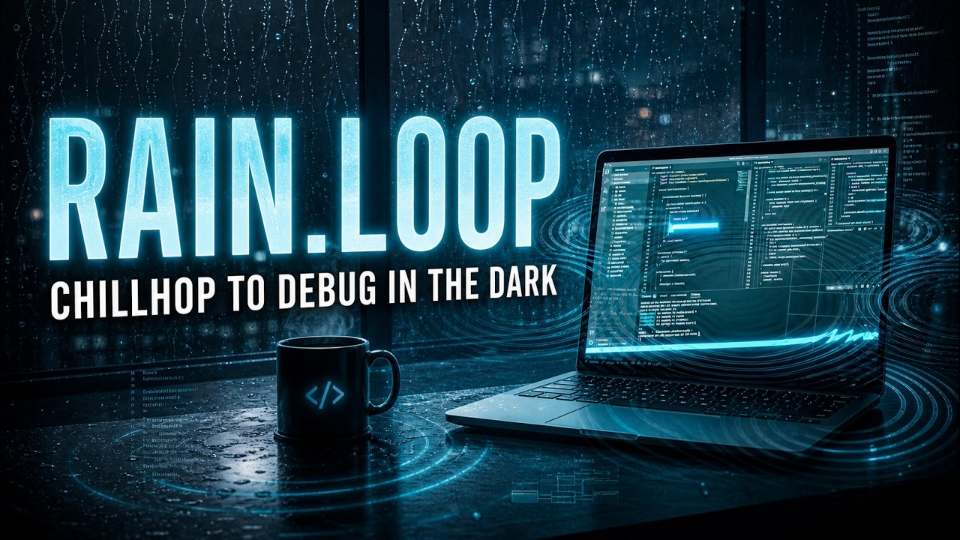
It's half past two. The merge request is open. The reviewer is offline. And outside, the rain keeps hitting the roof like it's writing its own commit message. There's a particular kind of focus that only shows up at this hour — no meetings, no Slack notifications, just you, the code, and whatever's actually broken.
That hour might be doing you more favors than it gets credit for. A 2024 study out of Imperial College London, analyzing cognitive test data from over 26,000 people, found that self-described night owls consistently outperformed early risers on measures of reasoning, memory, and processing speed — with "morning types" scoring lowest in both cohorts studied. The researchers were careful not to claim staying up late causes better cognition; chronotype looks like a real, largely biological trait rather than a habit you can just adopt. But if you already run late, the data at least says you're not fighting your brain by doing your hardest thinking after midnight — you might be working with it. Fewer social interruptions and a quieter environment likely compound the effect, giving late-chronotype brains the sustained, uninterrupted runway that complex problem-solving actually needs.
rain.loop was built for exactly that window. The track runs on warm Rhodes chords that stay harmonically simple on purpose — nothing that competes for the same mental bandwidth as debugging. A crisp snare keeps a light, steady pulse without ever pushing tempo, and a bassline holds everything down at 86 BPM: fast enough to feel alert, slow enough to stay out of the way.
A few notes on the build, for anyone curious:
- Tempo: 86 BPM — deliberately mid-range, avoiding both the drowsiness of slower tracks and the urgency of faster ones
- Texture: rain and rooftop ambience mixed low, present enough to register subconsciously without distracting
- Structure: minimal variation across the runtime — the goal was a loop you can forget you're listening to, not one that keeps announcing itself
That last point matters most. Most music asks to be noticed at some point — a hook, a drop, something that pulls attention back. rain.loop deliberately avoids all of it. It's meant to sit underneath four hours of uninterrupted work and disappear.
There's a reason the track leans into the image of talking things through rather than forcing an answer, too. Every developer eventually discovers some version of rubber duck debugging — the technique, popularized by the 1999 book The Pragmatic Programmer, of explaining your code line by line to a literal rubber duck on your desk. The duck doesn't answer. It doesn't need to. The act of slowing down enough to narrate the problem out loud is usually what surfaces the gap between what the code is supposed to do and what it's actually doing. rain.loop is built on the same principle applied to sound: nothing in the track talks back or demands a response, but having something steady to think alongside seems to make the thinking itself go easier.
Built for developers, late-night builders, and anyone who does their clearest thinking when the rest of the world goes quiet. Hit play, open the terminal, and let it compile. If this hits the right frequency, Ocean Breath works from a related angle — same patience, different metaphor — and Bergkristall strips things down even further for when the bug calls for total quiet instead.