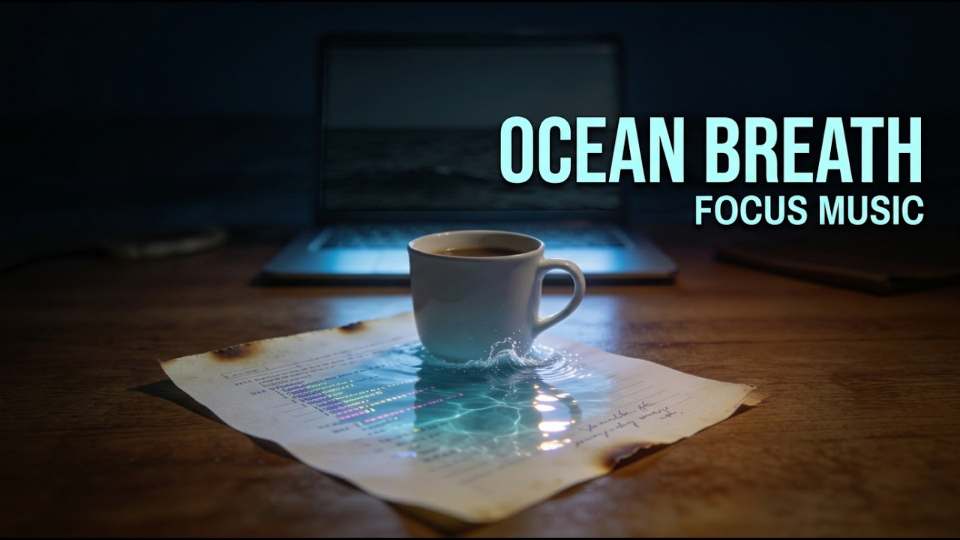
There's a moment late in a long work session when everything stops feeling like effort — when the problem you were fighting an hour ago suddenly opens up, and the solution arrives not through force but through patience. Ocean Breath was built for that exact moment, and for the long, unglamorous stretch of work that leads up to it.
Rhythmic wave textures form the foundation, washing in and out at a steady, unhurried pace — not quite a beat, more like breathing set to sound. Shimmering watery synth bells ring out over the top, bright but never sharp, dissolving almost as soon as they appear. Deep fluid basslines move underneath at 78 BPM, deliberately slow, like a tide that never rushes and never stops. Nothing in the track pushes forward; everything simply arrives, again and again, at its own unhurried pace.
That number — 78 BPM — isn't arbitrary. A 2025 study in the Annals of the New York Academy of Sciences found that slow-beat music measurably improves attentional orienting: people got better at focusing on relevant targets and ignoring distractions, their heart rate dropped, and they reported more calm and pleasure while it played. Separately, researchers have long pointed out that tempos in the 60–80 BPM range tend to sit close to a relaxed resting heart rate, which is one reason music in that zone can feel less like something you're listening to and more like something your body just settles into.
The water theme isn't just decoration either. Ocean sounds belong to a category psychologists call "soft fascination" — stimuli dynamic enough to hold attention gently, but predictable enough that the mind never has to work to follow them. This is the core idea behind Attention Restoration Theory, first proposed by Rachel and Stephen Kaplan: that certain environments and sounds let the brain's directed-attention system rest and recover, rather than draining it further. A 2021 meta-analysis covering dozens of studies on natural soundscapes found consistent evidence for improved mood, reduced stress, and better cognitive performance after exposure to sounds like waves, rain, and birdsong — and a separate study using recordings, not real beaches, found that listening to ocean sounds shifts people toward external, present-moment focus and away from the kind of looping, ruminative thinking that derails concentration.
That's the real overlap the title points at — shoreline and syntax. Both reward a kind of steady, repetitive attention rather than sudden bursts of effort. Waves don't hurry the shore into shape any more than good debugging hurries a bug into revealing itself. Both work through repetition, through returning to the same spot slightly differently each time, until something finally gives. Separate research on instrumental "focus music" specifically — as opposed to music with lyrics — backs this up from the other direction: a Georgetown-led study published in PLOS One found that steady, tranquil instrumental tracks with no sudden melodic shifts improved both mood and task performance, even among people who started out anxious, without the sharp attention-splitting effect that lyrics tend to cause.
None of this is a claim that Ocean Breath will fix a stubborn bug for you. What the research does suggest is why a track built this way — slow, watery, repetitive, wordless — tends to fade into the background of a coding session instead of fighting for space in it, freeing up exactly the kind of patient, unhurried attention that debugging actually rewards.
This is focus music for the ones who write code like poetry and debug like meditation — people who've learned that forcing a solution rarely works as well as simply staying present with the problem long enough. If this kind of steady, water-built calm works for you, rain.loop leans into a similar patience from a more explicitly developer-coded angle, and Mar de Nubes drifts through the same watery stillness from higher up, somewhere between sea and sky. Let Ocean Breath run while you work, and notice how the sharp edges soften.